
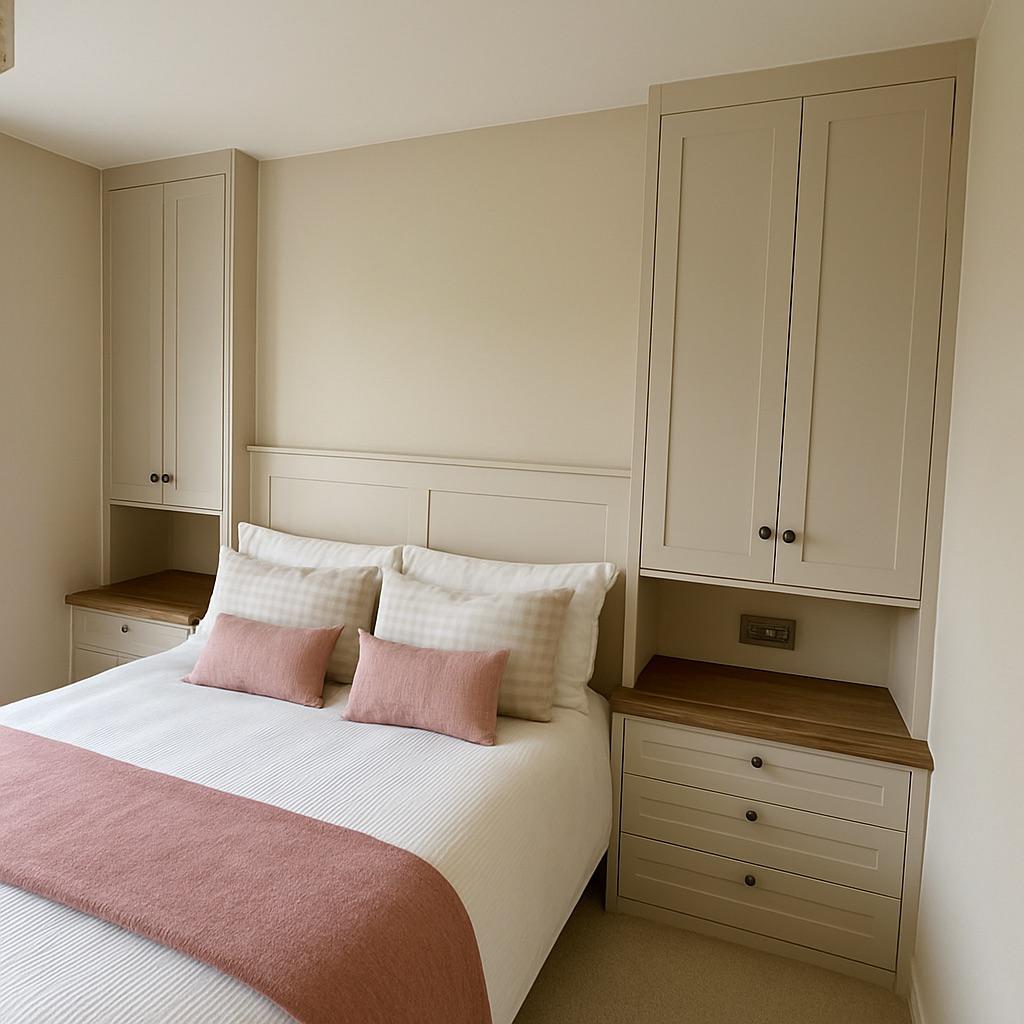
I often find that clients use the terms “joinery” and “carpentry” interchangeably, but they’re quite different disciplines as both a joiner and carpenter in Harrogate. Furniture joinery is the craft of cutting and shaping wood so that individual components lock together without relying solely on metal fixings.
It’s workshop-based work that demands precision, patience, and an understanding of how timber behaves over time.
When we create a mortise-and-tenon joint for a table frame or cut dovetails for a drawer, we’re using techniques that have remained fundamentally unchanged for centuries because they work.
The distinction matters. Carpentry tends to be site-based and structural: fixing roof timbers, building stud walls, that sort of thing. Joinery, on the other hand, is about fine detail and accuracy. We might spend half a day fitting a single joint so that it closes with just the right amount of resistance, tight enough to hold, but not so tight that it splits the material.
Let’s look closer at the art of joinery here at our workshop.
Ready to choose fitted furniture in Harrogate? Bailey Joinery provides bespoke fitted furniture joinery services for homeowners across Harrogate, Knaresborough, and York. Contact us today for your custom furniture solution. Call: 07883 318 886
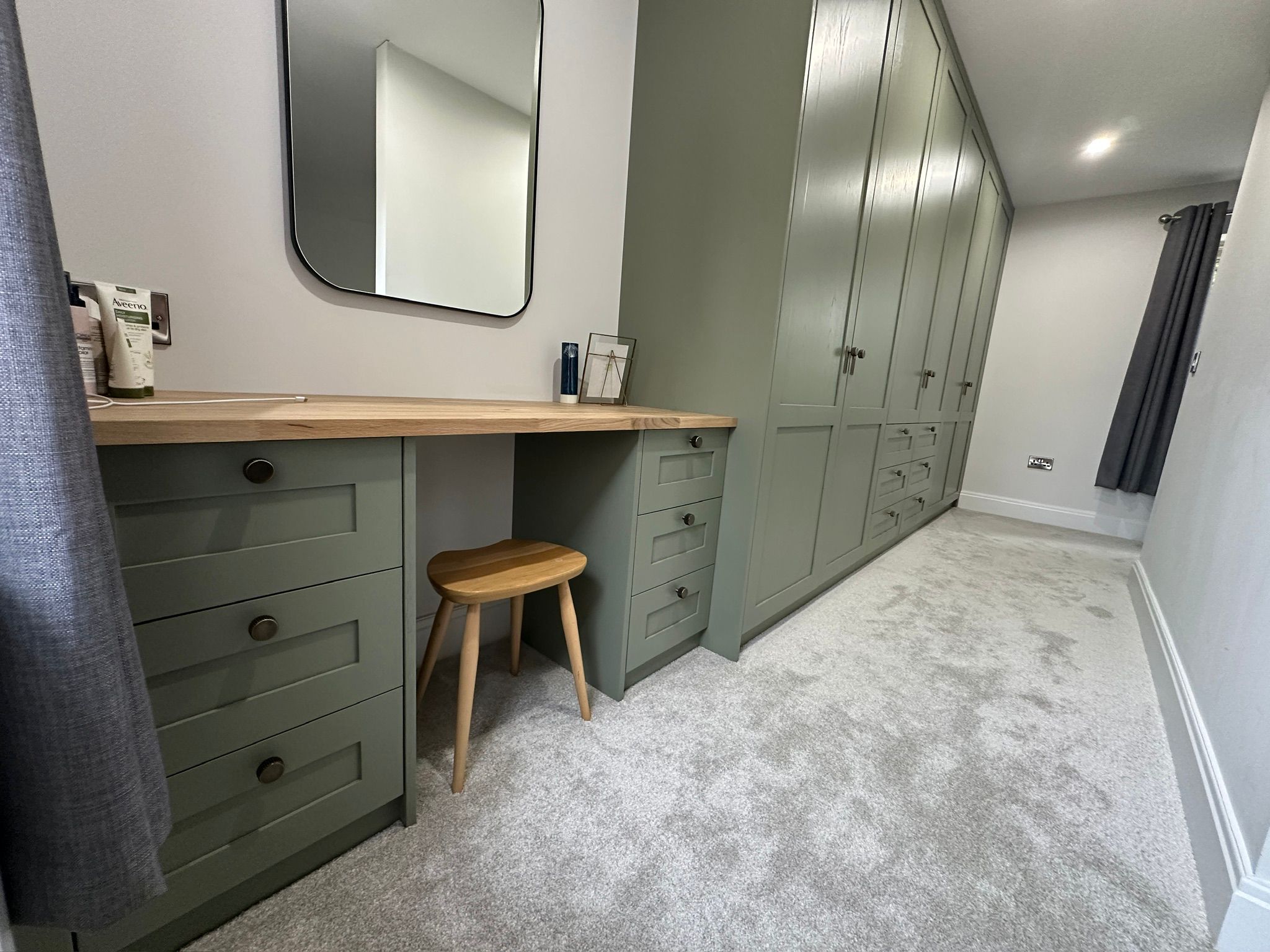
You’ll find furniture joinery in everyday use all around Harrogate and North Yorkshire
Solid oak dining tables that will last for generations, built-in wardrobes in Victorian terraces, shop counters and reception desks in commercial premises. These pieces rely on joints that can cope with the stresses of daily use while looking beautiful for decades.
The UK climate adds another layer of complexity for any carpenter in Harrogate. Our humidity levels shift with the seasons, and timber responds by expanding and contracting. A joint that’s perfect in the dry heat of summer might crack in the damp of winter if it hasn’t been designed to accommodate movement. This is why we choose specific joint types for specific applications,it’s not just about strength, but about building furniture that remains tight and stable through plenty of seasonal cycles.
Well-executed joints can be a visible design feature or completely hidden. Exposed dovetails on a drawer front make a statement about craftsmanship; biscuits and pocket screws in modern fitted furniture stay out of sight entirely.
Both approaches have their place, and understanding when to use each is part of what separates professional joinery from DIY.
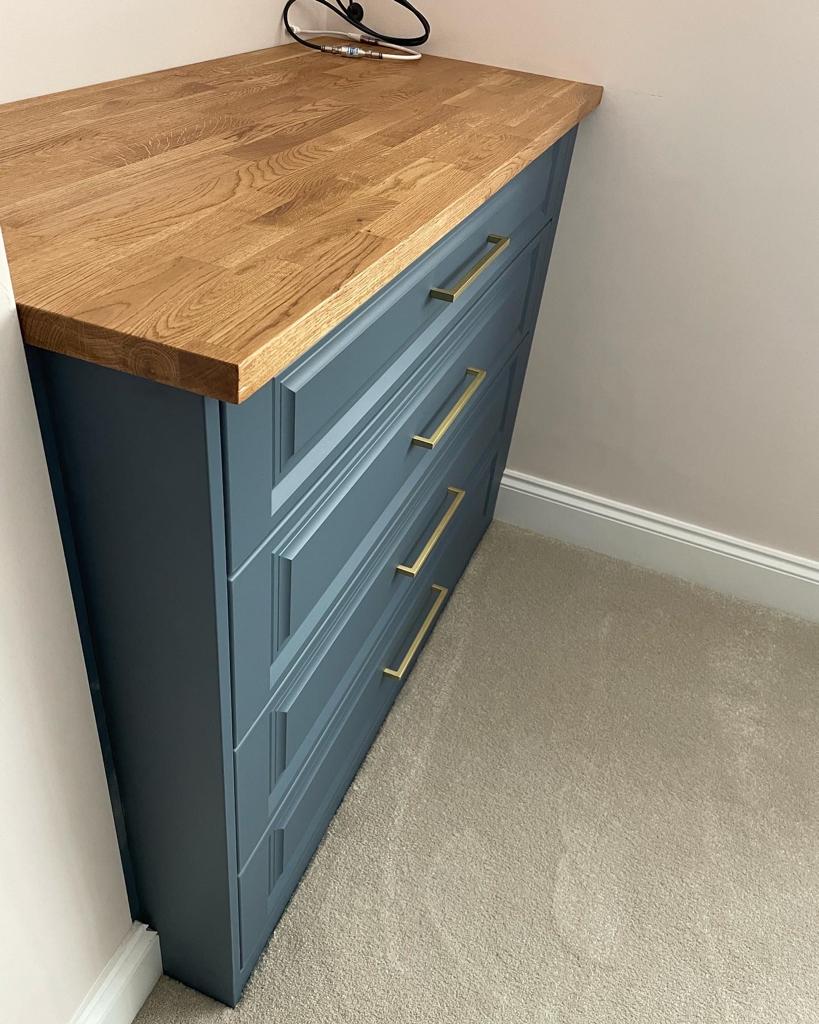
Core Furniture Joint Types and When We Use Them
There are dozens of joint variations in the woodworking tradition, each developed to solve a particular problem. In this section, we’ll focus on the core joints we regularly use in furniture projects around Harrogate, the ones that cover the vast majority of our work for domestic and commercial clients.
Butt and Mitred Butt Joints
The simplest joint is the butt joint, where two pieces of timber meet edge to edge or end to edge. On its own, it’s weak, suitable only for non-structural applications. We rarely use plain butt joints for fine furniture. Instead, we reinforce them with biscuits, dowels, or screws.
A mitred butt joint, where both pieces are cut at 45 degrees to form a corner, looks cleaner but shares the same structural limitations. We typically use these for trim and mouldings rather than load-bearing components.
Dowel and Biscuit Joints
For aligning components in tabletops, wardrobe carcasses, and shelving, dowel and biscuit joints are our go-to modern methods. Biscuits are oval-shaped pieces of compressed wood that slot into matching grooves cut into both pieces; they swell with glue to create a tight bond. Dowels work on a similar principle. Both methods are quick to execute with the right tools and produce a hidden, clean finish, perfect for contemporary fitted furniture.
Dado and Rabbet (Rebate) Joints
When we need to locate shelves or backs in bookcases, cabinets, and media units, dado and rabbet joints are essential. A dado is a groove cut across the grain to receive the edge of another piece; a rabbet is a step cut along the edge. We used this combination recently in a built-in alcove bookcase for a Harrogate townhouse—the dados hold fixed shelves at precise heights, while the rabbet neatly captures the back panel.
Mortise-and-Tenon Joints
The mortise-and-tenon is often called the “king of frame joints,” and with good reason. A rectangular tenon on one piece fits into a corresponding mortise (a square hole) on another, creating a joint that resists racking forces and carries significant load. We use this type for table legs, chair frames, door frames, and painted shaker cabinet doors. The beauty of the mortise-and-tenon is its scalability—you can adjust the size and depth to maximise strength for any two parts being joined together.
Box (Finger) Joints and Dovetails
For drawer construction and wooden boxes, interlocking corner joints are the standard. Box joints (also called finger joints) have straight, interlocking pins that look like interlaced fingers. Dovetails have angled pins and tails that lock together mechanically, making them extremely resistant to being pulled apart. Dovetails are stronger and more traditional; box joints are faster to cut and suit a more industrial aesthetic. We choose based on the piece’s purpose and the client’s preferences.
Tongue-and-Groove Joints
When we’re building solid timber panels—tabletops, cabinet backs, wall panelling—tongue-and-groove joints help us control gaps and movement. One edge has a protruding tongue, the other a matching groove. The pieces slot together tightly, allowing the panel to expand and contract without opening up visible gaps. This is particularly important in the UK climate.
Pocket-Hole Joints
Pocket-hole joinery involves drilling angled holes and driving screws through one piece into another. It’s fast, strong enough for many applications, and extremely beginner-friendly. We use it for internal framing, face frames, and one-off built-ins where the screws will be hidden once the piece is installed. However, we won’t rely on pocket holes for heirloom furniture or heavily loaded components—some things deserve more robust solutions.
Choosing the Right Joint
Ultimately, we choose the joint type based on three factors: load (how much stress will the joint bear?), timber species (hardwood or softwood, how does it machine?), and visibility (will the joint be seen or hidden?). Getting this decision right at the design stage saves time and ensures the finished piece performs as expected.
Traditional Joinery for Fine Furniture
When longevity and craftsmanship are the priorities as a carpenter in Harrogate, we still rely on traditional joints that have stood the test of time. These methods take longer to execute, but they deliver furniture that can be passed down through a family for generations.
Through Dovetails
For drawer sides and solid chests, through dovetails are hard to beat. The interlocking pins and tails create a mechanical bond that resists pulling forces even without glue. Carefully laid-out dovetails are also a statement of quality, anyone who knows woodworking will recognise the skill involved. We use these on pieces where the joinery will be visible and appreciated.
Half-Blind Dovetails
Sometimes clients want the strength of dovetails without the visible end grain on the front of a drawer. Half-blind dovetails solve this problem: the tails are hidden behind the drawer front, leaving a clean, paintable or venerable surface. We often use this approach in fitted bedroom suites for Harrogate new-builds, where a contemporary look is preferred.
Classic Mortise-and-Tenon Frames
Chairs, tables, and internal doors all benefit from mortise-and-tenon construction. For period properties in North Yorkshire, we sometimes add pegged tenons, a wooden pin driven through the joint to lock it permanently. This is a heritage detail that matches the character of older buildings and provides additional security against the joint loosening over time.
Bridle and Half-Lap Joints
Bridle joints and half-lap joints are simpler variations on the mortise-and-tenon theme. We use them in frames for tables, headboards, and shelving ladders. A bespoke oak hall bench or boot room storage unit might feature half-lap joints where the components cross, strong, attractive, and efficient to produce.
Replicating Original Joinery
For listed and heritage buildings in and around Harrogate, we often need to replicate original joint types so that new furniture and joinery blends with existing fabric. This might mean matching a specific moulding profile or using a joint style that was common in the Victorian or Edwardian period.
We take this work seriously; it’s about respecting the building’s history.
Hand-Tool Work
Where appropriate, we cut dovetails and pare tenons by hand. This is slower than machine work and affects both cost and lead-time, but the results have a character that’s difficult to achieve any other way. Hand-cut joints often have subtle irregularities that catch the light differently, giving the finished piece a warmth and authenticity that discerning clients appreciate.
Ready to hire a carpenter in Harrogate? Bailey Joinery provides bespoke fitted furniture joinery services for homeowners across Harrogate, Knaresborough, and York. Contact us today for your custom furniture solution. Call: 07883 318 886